
Product descriptions that sell: a simple template for your catalog
A beautiful photo with a vague description leads to questions in your DMs and few sales. Here's a 5-part template to copy, with before-and-after examples for clothing, sweets and handmade goods.
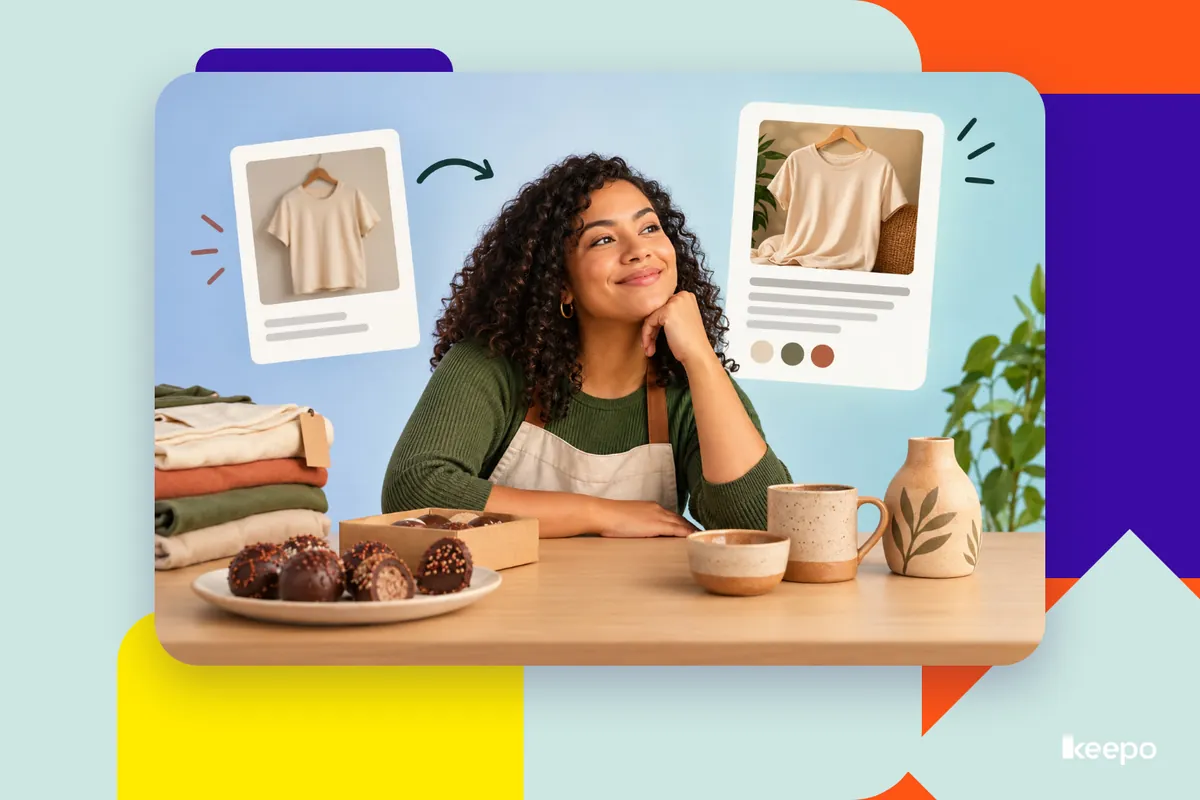
You post the photo, nail the lighting, and what lands in your DMs is: “What size is it?”, “What's it made of?”, “When will it arrive?”. Every question is someone who almost bought and stopped to wait for an answer. Some people wait. Many give up along the way. You can solve a good part of this before the question even comes up, with a well-written product description. Here you'll find a simple five-part template that works for almost any catalog, plus before-and-after examples for clothing, sweets and handmade goods.
Why a vague description costs you sales
The photo shows what the product looks like. The description tells what the photo can't show: size, material, flavor, lead time, care. When the text boils down to “Gorgeous, grab yours!”, the customer is left without the information to decide. Then they have three options: ask in your DMs, look somewhere else or put it off. Only the first one is good for you, and even that costs you time.
Think of the description as the service you'd give in person, only in writing and available at any hour. Someone who arrives through your link in bio at eleven at night can decide on their own, without waiting for you to wake up.
The five-part template
It doesn't need to be long. It needs to be complete. Follow this order and you'll cover the most common questions.
1. A clear name: say what it is, no nicknames
The name is the first thing people read and, often, the only thing. Swap creative names that explain nothing for names that describe. “Aurora Collection” doesn't say whether it's an earring or a candle. “Small gold hoop earring – Aurora Collection” does. A formula that works: product type + main feature + variation (color, flavor or size).
2. Who it's for or what occasion it suits
One or two sentences that help the customer picture themselves using it. Who it's for, when to use it, what need it meets. For example: “Perfect as a gift for a kid's birthday party” or “For sensitive skin and anyone who prefers a fragrance-free option”. Steer clear of promises you can't guarantee, like “the best in the country” or “instant results”.
3. Measurements, materials and what's in the package
This is where most DM questions come from. Be specific: measurements in centimeters, weight, number of units, yield, material, ingredients, available colors. For clothing, list the measurements for each size, not just S, M and L, because every brand fits differently. Also say what's included and, when it makes sense, what isn't.
4. How to use, store or care for it
A short instruction prevents disappointment after the purchase: how to wash it, how long it lasts outside the fridge, whether it can get wet, how to assemble it. This cuts down on returns and complaints, and it also builds trust, because it shows you really know what you sell.
5. Lead time, delivery and customization
Say whether it's ready to ship or made to order, how long it takes to make, how you deliver (pickup, courier, postal service) and to which areas. If you offer customization, explain what can be changed and whether that affects the lead time. A hidden lead time is a common reason people give up, and a common cause of annoyed customers later on.
Ready-to-copy template
Paste this into your phone's notes app and fill it in for each product:
Name: product type + main feature + variation
Who it's for: one sentence on who uses it, when they use it or what it's for
Details: measurements, weight, quantity, material or ingredients, available options
Care: how to use, wash, store or assemble
Delivery: ready to ship or made to order, lead time, shipping method and areas served
Before and after: examples to adapt to your product
The examples below are for illustration only. Use them as a reference and swap in the real details of what you sell.
Clothing
Before: “Gorgeous top, super comfy, lots of colors!”
After:
- Short-sleeve linen top – off-white
- For everyday wear in hot weather. Goes with jeans, skirts or tailored pieces.
- Sizes: S (bust 88 cm, length 60 cm), M (bust 94 cm, length 62 cm), L (bust 100 cm, length 64 cm). Linen-viscose fabric, no elastane.
- Hand wash or use the delicate cycle. Dry in the shade.
- Ready to ship. Ships within 2 business days.
Sweets
Before: “Delicious gourmet brigadeiros, order now!”
After:
- Box of 12 gourmet brigadeiros – assorted flavors
- For parties, gifts and party favors.
- Flavors: classic, powdered milk, pistachio and dark chocolate (3 of each). About 20 g each, in paper cups. Contains milk. Made in a kitchen that also handles peanuts.
- Eat within 3 days. Store in a cool place away from direct sunlight.
- Made to order, 48 hours in advance. Pickup on site or local courier delivery.
Handmade goods
Before: “One-of-a-kind piece, handmade with lots of love.”
After:
- Small handmade ceramic vase – green glaze
- To decorate a shelf or table, or to plant succulents and small plants.
- 12 cm tall and 10 cm in diameter, with a drainage hole. Handmade: each piece has slight variations in color and shape.
- Water-safe. Clean with a damp cloth.
- Made to order within 10 business days. Shipped by mail with protective packaging.
Notice that “made with love” still counts, but now it comes with the information that gets people to buy. And mentioning the variations in a handmade piece turns a potential complaint into part of its charm.
How to figure out what to write: your DMs already have the answer
You don't have to guess what to put in the description. Open your conversations from the past few months and jot down the questions that come up most. Each frequent question becomes a line in your text. If everyone asks whether the cake needs refrigeration, that information has to be there.
It's also worth looking at return requests and complaints. They show what the customer expected and didn't find. Once you've written it, ask someone who doesn't know the product to read it and tell you what's still unclear.
Common mistakes that keep the questions coming
- Adjectives only: “gorgeous”, “perfect” and “amazing” don't answer anything. Replace them with facts.
- Hiding the price: “DM for price” drives away people who just wanted to know if it fits their budget.
- Leaving out the lead time: anyone who needs the product by Saturday will either ask or give up.
- Wall of text: on a phone, one big block is tiring to read. Use short sentences and one piece of information per line.
- Copying the supplier's description: it's usually generic and sometimes includes details that don't apply to your product.
- Outdated description: a discontinued flavor, a sold-out color or an old lead time leads to frustration. Review it whenever something changes.
Get your catalog ready for customers to decide on their own
A complete description pays off more when the path to purchase is short too. With Keepo, you build a site with a catalog and put each product's photo, price and description in one place, right in your link in bio. Customers read, compare and reach out already knowing what they want, without having to exchange ten messages before placing an order.
To get started without getting stuck, do this:
- Start with your best-selling products and rewrite their descriptions using the template.
- Keep the same order of information across all items, so customers know where to look.
- If you take custom orders, use a form to collect the order details in an organized way.
- Review your catalog every time the season, menu or collection changes.
You won't get your DMs down to zero, and you don't need to. The idea is to save them for conversations that are really worth your time, while the basics are already answered. If you don't yet have a place to bring your products together with complete descriptions, create your Keepo, build your catalog with the template from this post and get your customers ready to decide on their very first visit.