Mini-site vs. landing page: which one is right for your online business?
Mini-site vs. landing page: find out which one to choose to attract leads, engage your audience, and grow your online business strategically.

Have you ever stopped to think about the best strategy for capturing leads, showcasing your products or services, and boosting your sales? When it comes to having an online presence, there are different formats that can give your business a lift. Two of the most interesting options are the mini-site and the landing page. Want to know more? We'll explain!
Whether you're an entrepreneur starting an online business, a marketer looking for new strategies, or someone who wants to test an innovative idea, understanding the differences between these two models is essential.
To help you understand the difference and figure out which of these options best fits your goal, we've put together this guide.
What is a landing page?
A landing page is a web page created for one very specific purpose: turning visitors into leads. It usually has no navigation menu or external links, to avoid distractions.
Its main focus is to guide the visitor toward a single action, such as filling out a sign-up form, downloading a free e-book, registering for a webinar, or buying a specific product.
When users arrive on this page, whether by clicking an ad, an email link, or a social media post, they find information about a single product, service, or benefit, presented clearly and concisely.
One of the main goals of a landing page is generating qualified leads. Through simple forms that ask only for a name, email, and sometimes a phone number, you offer something valuable in return, such as an exclusive e-book, access to a webinar, or a newsletter.
By offering valuable content in exchange for contact details, you grow your contact list and attract only people who are genuinely interested in your content or service.
Another goal is to speed up sales with irresistible offers. By highlighting special promotions, exclusive discounts, or limited bundles, a landing page creates a sense of urgency that motivates visitors to act right away.
Landing pages are also great allies when launching new products or services. They serve as a stage for unveiling what's new, showing off key features, and inviting your audience to sign up for early access.
This format builds anticipation and creates a sense of community around the launch, attracting an engaged audience eager to try it firsthand.
What is a mini-site?
As the name suggests, a mini-site is a small website that brings together several pages related to a theme, product, or campaign.
Unlike a landing page, which puts everything on a single page, a mini-site allows for more complete and organized navigation and can include different sections, such as an about section, portfolio, social media links, customer testimonials, services, and a contact page.
In practice, it's a link in bio that does much more: rather than simply sending visitors to another page, it tells your story and presents everything your brand offers in an organized, visually appealing way.
For online entrepreneurs and content creators, a mini-site is the perfect tool to build authority and make it easier for your audience to find their way around.
With Keepo, you get customizable mini-site templates and a simple interface that make the creation process easy. You can choose themes, rearrange content blocks, and integrate everything, taking your online presence beyond the traditional link in bio.
Landing page vs. mini-site: key differences
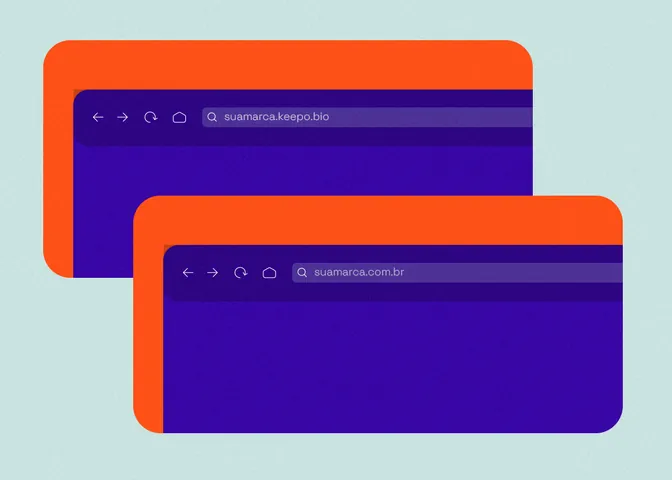
One of the main differences between a mini-site and a landing page is how they're hosted. A landing page is usually published on the same domain as the company's main website. A mini-site, on the other hand, is typically placed on a separate subdomain or even an entirely new domain, working as an independent extension of the website.
Their goals also differ. A landing page has a clear, direct focus: turning visitors into leads. That's why it presents a single offer and guides users toward a specific action, such as filling out a form or making a purchase.
A mini-site, in turn, is more flexible. It can serve a variety of goals, such as launching a new product, sharing content from a specific campaign, or creating personalized experiences for different audiences.
From a structural standpoint, a mini-site is more like a website, with several pages and internal navigation that lets users explore different sections. A landing page, by contrast, is a single page with a simple structure, designed to avoid distractions and lead visitors straight to the call to action.
Finally, because it's a single page, a landing page concentrates its SEO focus on one keyword, which makes targeted optimization easier but limits its reach for keyword variations. A mini-site lets you target different keywords on specific pages, increasing visibility in search engines and attracting more diverse traffic.
| Feature | Landing page | Mini-site |
| Hosting | On the same domain as the company's main website | Separate subdomain or an entirely new domain |
| Goal | A single action | Multiple goals |
| Structure | Usually no menu | With menus and submenus |
| SEO focus | Limited (single keyword) | Broad (multiple keywords) |
| Content depth | Brief and to the point | Richer and more detailed |
Which should you choose: mini-site or landing page?
Choosing between a mini-site and a landing page depends on your communication and marketing goals. Each format meets different needs and can be more or less effective depending on the context.
When to go with a mini-site
A mini-site is ideal for projects that aren't directly tied to the main brand but still need to be communicated strategically to the right audience.
It lets you present content in a more targeted and strategic way, especially when you want to create a distinct identity for a particular campaign, product, or initiative.
This format is also ideal for covering topics that complement the content on your main website, giving visitors a focused, contextualized experience. For example, when launching a new product or service, a mini-site lets you explore what makes it stand out in greater depth.
Another advantage is the ability to tailor your messaging to your audience's profile and interests.
If you want to rank for multiple keywords related to your business, a mini-site offers the ideal structure. Each page can be optimized for SEO with specific terms, expanding your organic reach and attracting qualified traffic from different segments.
Finally, by offering more interactive navigation and varied content, a mini-site can encourage greater user engagement and strengthen the connection with your brand.
Check out our post with SEO strategy tips to boost your mini-site's visibility.
When to use a landing page
A landing page is the ideal choice when your main focus is driving conversions. This type of page is built with a clear focus: getting visitors to take a specific action.
That's why it's most often used in promotional campaigns, paid ads, and other strategies that call for a direct response. A landing page's structure is designed to eliminate distractions, highlighting only the main message or offer.
This format is especially effective when launching a product or service. You can highlight offers, present promotion details, and create a sense of urgency, guiding visitors straight to purchase or sign-up within the set time frame.
Landing pages are also widely used in paid traffic campaigns. When you run Facebook Ads, Google Ads, or Instagram Ads, a landing page ensures the traffic you generate goes to a clean, focused conversion page. This improves your ads' quality score and lowers your cost per acquisition, since users find exactly what they're looking for without distractions.
So if your goal is to prompt immediate action, a landing page is undoubtedly the most suitable tool.
Create your landing page or mini-site with Keepo!
Deciding between a landing page and a mini-site requires clarity about your goals and the level of depth you want for your online business.
When your goal is a quick conversion, such as capturing leads or selling directly, a landing page makes more sense. On the other hand, if you want to build authority, grow organic traffic, and offer a richer brand experience, a mini-site is the right choice.
Each format plays a strategic role in your marketing funnel: use landing pages for one-off actions, quick launches, and market validation, and turn to mini-sites for long-term campaigns that demand robust SEO.
Ready to take your online presence to the next level? Try creating your mini-site or landing page with Keepo and see how quick and easy it is.